Latest News

Do Cold Air Intakes Really Work?

AIRAID Cold Air Intake system

AIRAID Cold Air Intake systems work by replacing the restrictive parts of the factory intake system with those designed to optimize the flow of clean, cool outside air to the engine.

Cold air intake systems have been around for many years, and they have long been proven to increase vehicle power and performance. Cold air intakes have been the subject of countless magazine articles, television show segments, and independent tests, where in nearly all cases the intake systems manufactured by reputable companies like AIRAID have shown an increase in power. But how? Is it really as easy as slapping a racy-looking cone filter on the end of a tube? The answer is no, but it’s always a good idea to understand why a product works when shopping for upgrades to your own vehicle. Therefore, let’s take a closer look at exactly how cold air intake systems work.

Stock intake tubes usually include a variety of noise-canceling baffles and corrugated sections

Stock intake tubes usually include a variety of noise-canceling baffles and corrugated sections, both of which hamper airflow to the engine and don’t allow the engine to run as efficiently as it could.

It’s important to understand two basic things when discussing cold air intakes. First, cold air is denser than warm air, meaning cold air packs more oxygen molecules into an engine than hot air. More oxygen leads to more complete combustion, which equates to additional power and efficiency. Secondly, an engine is essentially a big air pump. It draws in air to mix with fuel, ignites the mixture, and expels the spent air mixture out of the exhaust. In an ideal world, the engine would be able to inhale as much air as it needed and exhale it with no restrictions to airflow either coming in or going out. The problem in the real world, however, is that the process of an engine drawing in air and expelling burned exhaust gases is very noisy. Anyone that has driven a vehicle with a broken exhaust system or been near an engine that is running with the intake system disconnected can understand just how loud an engine can be. Further, there needs to be some way to filter incoming air from dirt and debris because dirt will damage engine internals.

AIRAID intakes replace the factory air box with a more open design

AIRAID intakes replace the factory air box with a more open design, which improves airflow and allows the use of a larger air filter than stock. The weather-stripping along the top of the box seals against the hood, keeping the filter isolated from hot engine compartment air.

To cut down on the noise, OEM manufacturers place various baffles and mufflers on both the intake side of the engine and the exhaust, and they also add some type of filter to the inlet in order to protect the engine from foreign particles. The issue is that these baffles and mufflers seriously restrict the engine’s ability to inhale clean air and expel exhaust gasses. OEMs usually place a higher priority on noise reduction than engine efficiency. Factory designs often hamper engine performance further by placing the engine inlet duct in an area where it is exposed to hot engine compartment air rather than routing it to an area where the engine can draw in cool outside air. The end result is an engine that doesn’t run as efficiently or make as much power as it potentially could. Things like shrouded air boxes, undersized air filters, strategically placed baffles in the intake tubes, and inlet tracts routed near engine heat all restrict airflow and therefore hurt power and performance.

air filter adapter with venturi that smooths airflow to the engine

AIRAID uses several different methods to improve airflow. In this case, the filter adapter has a venturi built into it much like what you would see on a carburetor. A venturi smooths out and promotes additional airflow to the engine.

AIRAID cold air intake systems (and those from other reputable intake manufacturers) work by targeting the most restrictive portions of a typical stock intake system: the air box, the intake tube, and the air filter. They also place a priority on getting cool, outside air directly to the engine. Typical AIRAID Intakes replace all or a portion of the factory air box, which is where restrictions most often lie. By opening up the air box, the engine is able to draw in more cool outside air. The intake systems keep the air filter isolated from hot engine compartment air, make use of any factory cold air inlet duct present, and also add additional forward-facing areas for cold outside air to be drawn into the filter. A new intake tube often replaces the factory tube that is typically full of baffles and corrugations, and these replacement intake tubes further optimize airflow to the engine. The AIRAID intake tubes have provisions for any factory breathers and sensors, and ensure that mass air flow (MAF) sensors (when present) are in a position to work properly with the factory calibration. In the vast majority of cases, AIRAID intake systems do not require an aftermarket tune. To top it all off, AIRAID uses a large premium filter to keep the engine supplied with plenty of cool air without sacrificing filtration. AIRAID purposely increases the size of the filters used with an intake, which increases the surface area of the filter media. The larger the surface area, the greater the volume of air that a filter can pass while trapping harmful particulates. More surface area also means that a filter can go longer between cleanings, which is why recommended service intervals for an AIRAID premium filter are often longer than a stock paper filter.

AIRAID air intake tube with PCV, breather hose and IAT sensor adaptors

AIRAID intake tubes always have provisions for all of the factory breather hoses and sensors to be retained with the intake system. In the case of this Mustang system, the installer can choose to keep or delete the factory sound tube that is routed to the engine compartment.

MAF sensor placement in air intake system

The placement of MAF sensors is critical with cold air intake systems. The insert on the right ensures that the MAF sensor receives a proper air signal with stock tuning, but the insert can be removed to provide additional airflow with custom tuning. This allows the intake to continue to work as additional performance modifications are made.

Though the principles of how cold air intakes work are fairly simple, the execution is pretty complicated. Air box and intake tube designs must increase airflow to the engine without creating additional turbulence, and the placement of certain sensors in the airflow path is critical. As modern engines and their management systems get more complex, they also become more sensitive to changes from the factory configuration. It is for these reasons that there are many hours in design and development work that go into each and every AIRAID intake. The newest AIRAID intake systems are designed using the latest computer modeling software, and sophisticated tools like flow benches and 3D printers to ensure a premium, well-fitting intake system. Further, each application is subject to countless hours of dyno testing and real-world driving conditions to ensure that every intake performs as it should without introducing any problems or “check engine” lights. Today’s vehicles often have more computing power than the typical home computer, so the days of simply sticking a filter on the end of a tube are long gone. By applying these and other tricks of the trade, AIRAID cold air intakes allow the engine to draw in more outside air, which in turn leads to more complete combustion and results in more power and acceleration.

To view all the AIRAID performance products for any vehicle, use the AIRAID Product Search by Vehicle tool. Also you can find a local AIRAID retailer by plugging your location into the AIRAID Dealer Search as well.

clear

AIRAID PRODUCT SEARCH     WHERE TO BUY AIRAID

AIRAID Sponsored Driver Jordan Priestly Starts Race Season In New 2016 Chevy Camaro

MAVTV camera crew and AIRAID driver Jordan Priestley

The MAVTV camera crew documented AIRAID driver Jordan Priestley’s success as he placed second and third overall in the GT Class at the Optima Thunderhill Raceway

Before attending his first official race for the year, AIRAID driver Jordan Priestly took advantage of a local SCCA event in his 2011 JDP Motorsports Camaro for some extra seat time. The plan was to take both his 2011 and 2016 Camaro to Thunderhill Raceway for Optima’s Search for the Ultimate Street Car Race Series. Priestly is no stranger to these events. In fact he has done very well in the Optima Series, placing podium several times throughout last year as well as receiving multiple invites to compete at the Optima Ultimate Street Car Invitational throughout the past couple years.

JDP Motorsports 2016 Chevy Camaro

Jordan’s race schedule includes the Optima Series, NMCA West Autocross, SCCA, NASA, and the upcoming CAM Challenge

The JDP Motorsports 2016 Camaro was purchased mid December of last year. There was a lot of work to be done if Priestly planned on taking both cars to the first Optima event in California. Very few, if any, drivers had registered two different cars at an Optima Race with the intent for one driver to race both vehicles. Yet, this is exactly what Priestly had planned on doing at Thunderhill Raceway.

Surprisingly the 2016 Camaro, named Evilynn, did exceptionally well, placing second in its class after day one. Priestley’s 2011 Camaro had some grip issues on the autocross resulting in a fifth place ranking Saturday evening. By the end of Sunday Priestly took podium once again with a second and third place win in the Optima Series GT Class. Frankey, the 2011 Camaro, had pulled through after completing the Hot Lap Challenge with a second place overall finish while the 2016 Camaro took third. Jordan had commented that if not for the Design Challenge, Evilynn may have won first. This was pretty impressive since the 2016 Camaro was close to stock. Unfortunately, the stock appearance of the car resulted in a lower Design Challenge score, pushing Evilynn out of first and into third place overall.

AIRAID sponsored 2016 Camaro

Though almost stock, the AIRAID sponsored 2016 Camaro had no problem keeping up with the other competitors at the NMCA West Autocross

Once back at JDP Motorsport, Priestly swapped the tires on the 2011 Camaro for a new set of BFGoodrich Rival S tires in addition to some freshly built Ultimate Performance Detroit Speed/JRI dampers. As for the 2016 Camaro, there were no plans for upgrades before Priestly’s next race in Fontana. Before Optima Thunderhill Raceway, Evilynn did get a new set of Forgeline GA1R’s along with BFGoodrich Rival S tires. Though Priestly had kept the car almost stock, his plans for further modifications was just getting started.

Priestly first place in Modern Muscle Class at NMCA West Autocross

Priestly placed first in the Modern Muscle Class at the NMCA West Autocross in his 2016 JDP Motorsports Camaro

Both vehicles were loaded into the JPD Motorsports trailer once again for round two in Fontana, California. Priestly registered both Camaros to compete, this time at the NMCA West Hotchkis Autocross. The two-day autocross was the first of four throughout the 2016 season. In order to compete for the overall Hotchkis Cup at the end of the year, a driver must compete in all four two-day events. Once again Priestly jumped between the drivers seat of two cars, not only shaking them down for the next Optima race, but also trying for a chance to win the Modern Muscle Class at the NMCA West Autocross.

2016 Camaro at OUSCI

Priestly left the 2011 Camaro at home to focus on the 2016 Camaro in Las Vegas, earning a second place win in the GT Class and securing him an invite to compete at OUSCI

By Sunday, the 2011 Camaro was not cooperating with Priestly, but the 2016 Camaro was handling exceptionally well. Priestley’s main competition was a 2011 Corvette driven by a father and son team, who had remained in first all of Sunday. On one of Priestley’s last laps Sunday evening, the 2016 JPD Motorsports Camaro pulled ahead of the Corvette’s time and into first for the Modern Muscle Class win.

The drive back to Utah was followed more upgrades for the ’16 Camaro including a harness bar and changes to the interior just in time for the Optima Las Vegas Motor Speedway event. New decals were also added; similar to those Priestly was sporting on his 2011 Camaro. Priestly decided to keep Frankey at home for this race and focus his attention on the ’16 Camaro.

Priestly, his wife Aimee and three-month old daughter

Priestly was in good company as his wife Aimee and three-month old daughter came out to Las Vegas Motor Speedway

Priestly was in good company during the Optima Las Vegas Race as his wife and three month old daughter joined him for the weekend. Weather was good, track conditions were ideal and Evilynn was running great. Priestly found himself once again in a battle for first with AIRAID driver Ken Thwaits in his 2014 Z28 Camaro. By the end of Sunday Thwaits took first in the GT Class while Priestly and Evilynn placed second. Since Thwaits had also won the Thunderhill Raceway event, he had already won an invite to the Optima Ultimate Street Car Challenge (OUSCI). This meant that Priestley’s second place win would include an invite to OUSCI. This was a huge accomplishment since only five competitors would be going home with invites after the Las Vegas race.

Priestly behind the wheel of his AIRAID equipped Camaro

We can expect to see Priestly behind the wheel of both the AIRAID equipped 2011 and 2016 Camaro throughout the remainder of the 2016 race season

Priestly will be making his way back to Fontana, California for his next race in two weeks. We have not heard if Priestly will be competing in the CAM Challenge with both Camaros or just Evilynn. As Evilynn gets faster, it is more likely that we will see Priestly behind the wheel of this Camaro, though he will also have Frankey out at certain race events throughout the remainder of the season.

It can become very tiring to race two vehicles in the same race, but we have been extremely impressed by Jordan’s ability to jump between the two cars. Though Frankey and Evilynn are very different cars with different suspension setups, it does not look like Priestly is having trouble going from one car to another. We will continue to follow-up on AIRAID driver Jordan Priestly, Frankey, and Evilynn as they continue to race their way through 2016, hopefully seeing them place podium several more times throughout this year.

clear

AIRAID PRODUCT SEARCH     WHERE TO BUY AIRAID

Matt Lovell Racing at the Mint 400 Sees Tough Breaks with a Big Effort

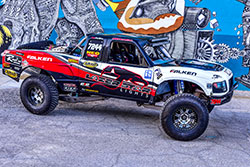
Matt Lovell’s #7244 all dressed and ready for the big event in Las Vegas, Nevada

Matt Lovell’s #7244 all dressed and ready for the big event in Las Vegas, Nevada

Coming off back-to-back wins at the SNORE Rage at the River this past December, AIRAID-sponsored Matt Lovell and his team had high hopes coming into the Mint 400. After taking a break from the Parker 425 to focus his efforts on building a new race truck as well, as prepping the #7244 mid-size trophy truck, Matt and his team were ready to tackle whatever the Mint was able to throw in their path. Unfortunately, some unforeseen obstacles dashed the team’s hopes for a win, but Matt and his team gave it their best effort on one of the most brutal courses in recent memory.
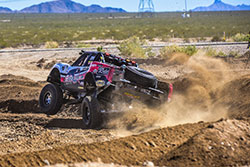
Matt Lovell attacks the course in his AIRAID-equipped truck at the Mint 400

Matt Lovell attacks the course in his AIRAID-equipped truck at the Mint 400

The Mint 400 has a long history dating all the way back to the 1960s. Originally organized by the Mint Hotel and Casino in downtown Las Vegas, the Mint has had its ups and downs throughout the decades. Today it’s more popular than ever before thanks to its resurrection in 2008. Virtually every known desert racer has entered the Mint 400, and a lucky few have even managed to win it. Unfortunately for many more, the legendarily brutal course has claimed more than its fair share of entries. Simply finishing the Mint is an accomplishment, let along making it to the podium. This year’s Mint 400 had a record number of entries, and Matt Lovell’s #7244 truck was lucky enough to draw first off the line for the 7200 class. This meant plenty of clean air and a chance to stay at the front of the pack.

Matt Lovell assembled a team of nearly 25 people consisting of friends and family members, all of them volunteering their time to help get #7244 to the finish line. After participating in the parade down Las Vegas boulevard with fiancé Jesse in the passenger seat, Lovell and the team took part in tech and contingency. Basically a giant party on Fremont Street in downtown Vegas, contingency for the Mint is the stuff of legend. As expected, Matt Lovell’s entry passed through tech with flying colors and also spent some time at several sponsor booths, including LazerStar Lights, Raceline wheels, King Shocks, and Falken tire. After a quick photo shoot with SnM Media, the team relocated to Primm, Nevada, which was the starting point for the Mint 400 this year.

Race day came early for the team as they made final preparations to the truck, organized spares and gear, and divided the team into three groups that would staff the main pit, plus two remote pits. The Mint is a loop race, so Lovell would have to make three laps on the 130-mile course. A loop race also means a full day of dodging slower vehicles and staying out of the way of the faster trophy trucks and Class 1 cars. Lovell lined up in the front of the 7200 class along with navigator Rob Nelson, all strapped in a ready to go. The green flag dropped and the duo was on their way, gunning to stay in front of the pack and make good time through the first lap.
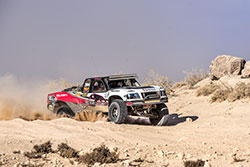
The 2016 Mint 400 proved to be one of the toughest ever, and the desert took its toll on the competitors

The 2016 Mint 400 proved to be one of the toughest ever, and the desert took its toll on the competitors

The course for the Mint turned out to be more brutal than ever before. Already challenging on its own, the course was further chewed up with other classes that had run that morning, plus several additional classes that started in front of the 7200 class. All these vehicles took their toll on the course, making deep ruts, cavernous whoops, and kicking rocks and boulders into the two-track course through the Nevada desert. Lovell reported that the course was the worst that he’s seen in 7 years of racing. About 15 miles from the start, they experienced their first flat, caused by hitting a rock at high speed. Lovell and Nelson had the tire changed in under 8 minutes, but then managed to get stuck while getting back on the course. They spent another 30 minutes digging out but finally managed to get the #7244 on solid ground. Unfortunately for the team, this was just the start of the problems. Upon reaching the first remote pit to put a fresh spare on the truck, the pit crew noticed that the rear axle was leaking. The course was so rough that the axle had taken a hard hit to the fabricated ¼” steel Ford 9” housing right where an additional ¼” skid plate had been in place to help prevent damage. The skid plate had been torn away and a crack had developed in the housing, causing a serious leak. The pit crew sealed up the housing as best they could with silicone and topped off the housing, and Lovell roared out of the pit. Unfortunately, all of these delays had allowed the rest of the 7200 class to get by, but Matt was determined to reel them back in. He made good time to the second remote pit, where the crew once again sealed up the housing and topped it off with fluid. The course continued to be rough and was only getting worse, with Lovell estimating that he passed nearly 100 broken vehicles between the first remote pit and main, which is the starting point for lap 2. A second flat slowed them down again, but they rallied and made it to the main pit, where the truck was fueled, the rear axle housing was inspected and sealed again, the LazerStar lights were checked because nightfall was less than an hour away. Though a win was not in the cards at this point, Lovell and his determined crew were dead set on getting #7244 to the finish line.

Unfortunately, that was not in the cards either. The damaged rear axle housing took a second big hit somewhere between main pit and the first remote pit on lap 2, which caused the loss of all the differential fluid, which in turn caused the rear axle gears to fail. Most teams would have thrown in the towel at this point, but not Lovell. The Mint is a no-chase race, meaning that team members were not allowed to deliver spare parts to the damaged truck. Lovell located a friendly Best in the Desert official that was willing to bring him a spare 3rd member, which was located at the main pit. The crew met the BITD official and handed off the parts, which he then delivered to Matt (special thanks to the BITD crew). Lovell already had the rear axle apart and was waiting on the spares when the official arrived, but unfortunately during reassembly it was discovered that the damage to the axle housing was more extensive than initially though and some studs that held the 3rd member in place had sheared. There was simply no way to keep fluid in the damaged housing, which meant that the new gears would only last a short time before failing. With course closing times looming, the team had no choice but to accept that a finish was not in the cards this year. The Mint would be the first DNF that the #7244 team experienced in three years.

Not one to dwell on the past, Lovell is looking forward to Vegas to Reno, which is the next race on his schedule. Lovell has run AIRAID air filters exclusively on his race truck for several years and trusts no other filter to withstand the harsh conditions of desert racing. He uses a SynthaFlow oiled cone filter on the engine with a pre-filter and multiple breather filters for other critical drivetrain components. He reports that he rarely has to change engine filters during a race, and that the intake plenum on the engine is always spotless after a race, even one as long as Vegas to Reno (about 650 miles). He also uses AIRAID Helmet Air System filters to ensure he and his navigator breathe clean air regardless of course conditions. To find out more information about Matt Lovell and his team, visit www.mattlovellracing.com or follow him on social media, facebook.com/mattlovellracing, or on Instagram #mattlovellracing.

clear

AIRAID PRODUCT SEARCH     WHERE TO BUY AIRAID

Ultimate Street Car Race Series at Thunderhill Dominated by AIRAID Drivers

Brian Hobaugh and 2003 AIRAID equipped Corvette Z06 at 2016 OUSCI

Brian Hobaugh and his 2003 AIRAID equipped Corvette Z06 placed first in several race segments throughout the weekend

Optima’s Search for the Ultimate Street Car Race Series has become a popular and quickly growing event where street legal vehicles compete against each other to prove they are the “Ultimate Street Car.” In 2008 the Optima Ultimate Street Car Invitational was started, inviting high quality, award winning SEMA builds to prove their vehicle was truly a “street car.” What was once a race for only SEMA builds has now turned into a ten event series across the country. All genres of vehicles from muscle cars to modern muscle and imports to exotics are eligible to register for an Optima event. Though winning a single event earns bragging points, the real race does not start until November, when the Optima Ultimate Street Car Invitational takes place at Las Vegas Motor Speedway.

Brian Hobaugh and 2003 AIRAID equipped Corvette Z06 at 2016 OUSCI

Winning the autocross and speed stop secured Hobaugh’s first place overall standing in the GTS Class

Proving you have the Ultimate Street Car is more than just racing. There are five segments that help earn points towards your accumulative overall score. These segments include an autocross, a speed stop, a design challenge, a road rally, and finally a hot lap challenge. Though some competitors may favor one segment over another, the Ultimate Street Car must adapt and surpass its competition in all five segments. By obtaining the top points in each segment, drivers car hope to secure a podium finish at the end of the weekend. This is exactly what AIRAID drivers Brian Hobaugh and Ken Thwaits did at the Optima Search for the Ultimate Street Car Thunderhill Raceway event.

Ken Thwaits  2016 OUSCI

With one race down, AIRAID driver Ken Thwaits is on a mission to claim the Ultimate Street Car title

Brian Hobaugh’s AIRAID air intake equipped 2003 Chevy Corvette Z06 found its way to the podium at Thunderhill Raceway, finishing first in the GTS class. After scoring first on the autocross and hot lap segment of the race, Hobaugh secured his overall first place win while also receiving his invite to the Optima Ultimate Street Car Invitational (OUSCI) in November. The Z06 competed at the 2015 OUSCI, but Hobaugh was still shaking down his newly built Corvette at the time. Whatever Hobaugh did to the Z06 during the winter months seems to be working, and it showed at Thunderhill.

Ken Thwaits first place 2014 Z28 OUSCI

The 2014 Z28 has seen a first place finish in the GT Class before, but securing a win early on means Thwaits can focus on seat time before the final race

Ken Thwaits of Showtime Motorsports and his 2014 Camaro Z28 was the second AIRAID sponsored vehicle to win its class. The Z28 also had the opportunity to compete at OUSCI last November, though driver Cody Mason was behind the wheel at that time. Thwaits fought through some mechanic problems throughout the weekend not knowing if his standings in each segment would be enough to earn him first in the GT Class. By the end of Sunday, Thwaits was crowned winner, securing his spot alongside Hobaugh to compete again at the 2016 Optima Ultimate Street Car Invitational.

AIRAID sponsored Z06 and Z28 at 2016 OUSCI

With nine Optima events left before OUSCI, the AIRAID sponsored Z06 and Z28 will continue to follow the Optima Series throughout the remainder of the year

As the Optima Race Series continues to travel across the country, more AIRAID sponsored drivers will be found competing at these events. Though a Corvette has won OUSCI three years in a row, Ken Thwaits’ Z28 will be a tough contender at this year’s invitational. The questions is will it be enough to beat Danny Popp, three time champion, or the RS Motors crew, who have consistently come in a close second with their Mitsubishi Evos? Or will Brian Hobaugh and his 2003 Z06 take the lead to become this year’s 2016 Ultimate Street Car? Hobaugh has already seen victory back in 2013, winning OUSCI in his 1965 Corvette. Can he reclaim the title over Danny Popp or will it be someone new that takes home the title of the “Ultimate Street Car?”

To learn more about the air intake setups on these vehicles or to find vehicle specific air intake and performance air filter upgrades for your vehicle use the AIRAID Find Products Search. AIRAID performance parts can be purchased through an authorized AIRAID dealer. Find an AIRAID dealer with the AIRAID Dealer Search.

clear

AIRAID PRODUCT SEARCH     WHERE TO BUY AIRAID

2014-2016 Arctic Cat Trail 700 AIRAID Air Filter Provides Clean Air and Longer Ride Times

AIRAID premium filter for the Wildcat Trail 700

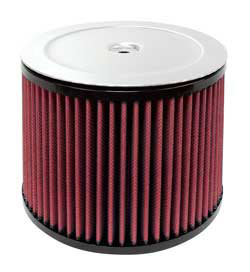
The AIRAID premium filter for the Wildcat Trail 700 features four layers of cotton gauze plus a synthetic layer in the filter media. It is reinforced with an inner wire mesh screen and includes a formed aluminum lid.

The UTV market has exploded in recent years with bigger and more powerful machines being released almost every month, but the bigger sizes don't help on tight trails. Arctic Cat has addressed the needs of those wanting to run Class 1 trails with the compact Wildcat Trail. The Trail is the perfect solution for winding through tight wooded trails and canyons, but the smaller engine can make it difficult to keep up with the more powerful side-x-sides in wide open spaces. AIRAID can help with a new washable and reusable premium air filter (part number 800-030) that allows the 2014, 2015, and 2016 Wildcat Trail's 700cc engine to breathe easier while maintaining effective filtration in the most demanding off-road environments. In addition to more free-flowing air, the new filter can go longer between cleanings, which means more ride time with less maintenance.

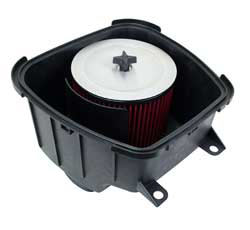
AIRAID filter for the 2014-2016 Arctic Cat Wildcat Trail 700 drops right into the factory airbox

The AIRAID filter for the 2014-2016 Arctic Cat Wildcat Trail 700 drops right into the factory airbox with no modifications needed. Installation takes just a few minutes.

The new AIRAID Wildcat Trail 700 air filter is a direct replacement for the factory filter element and installs right in the factory air box. The AIRAID filter is constructed with a durable polyurethane casing that will not warp or crack over time. The filter utilizes the company's SynthaFlow oiled filter media. The filter material includes four layers of cotton gauze plus a synthetic layer for superior filtration even in dirty off-road environments. The filter is further reinforced with a durable wire mesh inner screen so that it won't warp or deflect when tightened down. The AIRAID filter also includes a specially formed aluminum lid to maintain an effective top seal.

The AIRAID premium filter for the Wildcat Trail is washable and reusable, so it's the last filter you'll ever have to buy for your Wildcat. The filter is also backed by AIRAID's exclusive "No Hassle" warranty. The AIRAID Arctic Cat Wildcat Trail filter drops right into the factory air box with no modifications needed. For extended service intervals, AIRAID also recommends using the optional Pre-Filter, which is available separately.

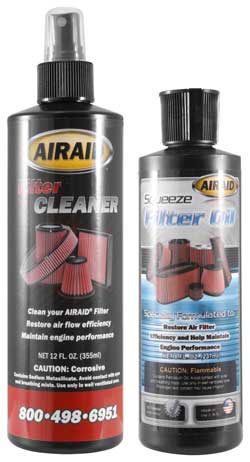
AIRAID 790-550 air filter cleaning kit

Periodic servicing with AIRAID's 790-550 Tune-Up Kit will ensure that the 800-030 air filter lasts for the life of your side-x-side.

Features and benefits for the AIRAID 800-030 Wildcat Trail Filter include:

  • Stock replacement filter for better performance
  • Great filtration with low restriction
  • Washable and reusable
  • Simple install takes only a few minutes

Applications for the Arctic Cat Wildcat Trail 700 include:

2016 ARCTIC CAT WILDCAT SPORT XT 700
2016 ARCTIC CAT WILDCAT SPORT LTD 700
2015 ARCTIC CAT WILDCAT TRAIL XT 700
2015 ARCTIC CAT WILDCAT TRAIL LTD 700
2015 ARCTIC CAT WILDCAT TRAIL 700
2015 ARCTIC CAT WILDCAT SPORT XT 700
2015 ARCTIC CAT WILDCAT SPORT LTD 700
2015 ARCTIC CAT WILDCAT SPORT 700
2014 ARCTIC CAT WILDCAT TRAIL XT 700
2014 ARCTIC CAT WILDCAT TRAIL 700

For more information on filters for a specific Side-x-Side or other powersports application, simply use the AIRAID Product Search Tool. For more information on AIRAID Drop-In air filters for all vehicles, visit our Drop-In Air Filter page. For more information about cleaning and servicing an AIRAID filter, including cleaning and servicing products, visit our AIRAID Filter Tune-Up page.

clear

AIRAID PRODUCT SEARCH     WHERE TO BUY AIRAID